A̱m’lala sa Ḵ̓umux̱se’
Song History
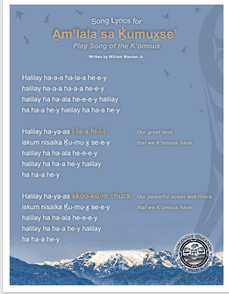
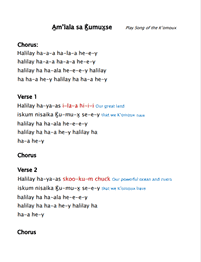
A̱m’lala sa Ḵ̓umux̱se’ was created in July 2018 for Indigenous Education (School District 71) to be sung by all students to celebrate Kwakwaka’wakw culture and language. A̱m’lala sa Ḵ̓umux̱se’ translates as ‘Play Song of the K’omoux’ and speaks to the great land “ila a hii” and the powerful ocean and rivers “skoo kum chuck” that are here within the lands of the K’omoux. The song was released into our School District in a ceremony held during a Professional Development Day on February 15, 2019.
Purpose of Song
From Kwakwaka’wakw teachings songs are used for many different reasons. There are songs composed to be used to travel by canoe, songs to welcome guests and songs to celebrate, or play. When someone composes a song, it is connected to not only them but also all their ancestors. There is song composition knowledge that has been passed down from one generation to the next. The song is more than just words; it expresses the story that is being told. Our Kwakwaka’wakw ancestors would listen to all the sounds around them to gain inspiration. The way rainwater drips off a leaf could guide the work of song composers. Not all words in each Indigenous language can always be fully captured by an English translation. The meaning of most songs goes much deeper than we realize (Jessie Everson – SD#71 Indigenous Engagement and Knowledge Specialist, 2025).
Use of Song Protocols
• Acknowledge the creator of the song (William Wasden Jr) from Alert Bay, British Columbia.
• Share the history and purpose of the song (see above descriptions).
• The song must be respectfully used in the style / format it was released (no changes).
Song Creator: William Wasden Jr. Bio
William Hiłamas Edward Wasden Jr. Waxawidi “Canoes Come to His Shore” was born at ʼYalis (Alert Bay) British Columbia on October 14, 1967. William is a member of the ‘Namgis Nation “Nimpkish Valley Tribe”. William carries many names and dances that have been bestowed on him by various sides of his families. William is also a descendant of the Cook, Wanukw, Hunt, Alfred, Harris and Innis families. He can also trace his ancestry to the Tłingit of Alaska and the Mowachaht of the West Coast.
William has taught most of his adult life in the majority of schools in the unceded Kwakwaka’wakw territories. He also ventures to share his knowledge of song composition with other nations along the coast.
William continues to teach all that he knows to the next generation of Kwakwaka’wakw. For many years, William has worked at the U’mista Cultural Center at Alert Bay BC as a researcher and cultural advisor. Recently, he has been rehired to return and continue work in language and history documentation for the Kwakwaka’wakw Nation.
For a full printable bio, click on the following link: William Wasden Jr Bio
Song Holders
For the gifting of A̱m’lala sa Ḵ̓umux̱se’ to take place, a dedicated group of people came together to help remember and carry the story of the song. This group became known as the Song Keepers of A̱m’lala sa Ḵ̓umux̱se’. In later years, the name shifted to Song Holders, to reflect their important role in sharing and passing this knowledge to others.
The Song Holders listed below have each chosen to carry this responsibility for as long as they feel called to do so.
- Yolanda Lehton
- Jessie Everson
- Colleen Devlin
- Alex Jules
- David Dawson
- JoAnn Restoule
Ways to learn A̱m’lala sa Ḵ̓umux̱se’
When learning a song there is more than one way to remember it. It is important to connect with the song as well and one way you can do this is to:
- Learn to drumbeat of the song first and only focus on that till you feel comfortable to sing the words as well, or
- Learn the words of the song and practice them till you can add in learning the drumbeat of the song
With these two ways to learn A̱m’lala sa Ḵ̓umux̱se’ we can also first learn the chorus of the song and then learn the verses 1 and 2 after that and then once we are comfortable with all the parts, we sing it all as one song!
There is more than one way to learn A̱m’lala sa Ḵ̓umux̱se’ and it’s important to remember that while we learn.