Canoes – st’iXim and spilus
We invite you to join us on a journey connecting us to place while we learn how to be good guests on the unceded territories of the Pentl’atch, E’iksan, Sathloot and Sasitla Nations.
Our Goals for This Learning Journey:
- To ensure inclusion of local pentl’atch peoples’ knowledge and perspectives is done respectfully and without appropriating knowledge.
- To contribute to revitalization of and continued understandings of skills, knowledge, and perspectives of First Peoples, for all students.
- To encourage and support respectful development of local teaching and learning resources.
- To contribute to understanding that the canoe and the land are our teachers. And that respect, care, and reciprocity are a key to that relationship.
History
These canoes came to our school district as the result of collaboration between Indigenous Education and the Lake Park Society. Since then, we have meet with Knowledge holders of the Pentl’atch families to gather knowledge that can be shared with you and your students as we learn how to be in the Canoe as well as knowing the history of where we are.
In 2022 and 2023, Indigenous Education purchased two Pacific Dancer fiberglass canoes from Clipper Canoes. These canoes are “patterned after canoes designed and used for hundreds of years by First Nations People along the West Coast.”
About Lake Park Society’s School Programs: “Lake Park Society (LPS) offers a variety of full-day outdoor education programs in May and June. Each of our grade-specific programs are BC Curriculum aligned and developed by BC-certified teachers to inspire inquiry, build core competencies, and nurture student’s connection to place.”
School Programs – Cumberland Lake Park & Campground
Naming and Blessing Ceremony
It was important to the community members involved in this journey that we do our work in a good way, identified in the above goals. A part of this work included the naming and blessing of the canoes.
In a ceremony held on March 12, 2025 at Comox (Pentl’atch) Lake, Jessie Recalma gifted pentl’ach names for the two canoes. The canoes were blessed in traditional ceremony and the work included the calling of witnesses and oral history sharing from local knowledge holders.
These two canoes were named:  st’iXim (sun), and spilus (moon).
Jessie, who is a language worker within his nation, chose these names to represent the deep connections between the natural world and the teachings that will take place on and near the water in the future. Here is a link to the Qualicum First Nation Website describing the deep work they have doing to revitalize the pentl’atch Language: pentl’ach Reawakening the language. Here is an article describing this journey from the First Peoples Cultural Council: On November 17, 2023, pentl’ach was officially announced as a living language in B.C.
The ceremony was a powerful expression of respect, culture, place, and community. For more information about this day please click here: SD 71 Article – Canoe Blessing and Naming Ceremony at Comox (Pentlatch) Lake.


Learning Considerations
Intentions
We invite you to reflect about how teachers, as visitors or guests to this land, can be aware of and create space for dynamic local culture, history and knowledge in a meaningful way.
We encourage you to think about your intentions for participating in this experience and ask:
- Am I acknowledging the diversity and history of the K’omoks First Nation?
- How do these intentions honour and relate to First Peoples Principles of Learning?
- Am I treating all learners inclusively?
- What do we already know? What do we need to know? What questions do we have? How can we get started on this journey?
- How are we including, honouring, interconnecting, reciprocating?
- How do we intend to share this experience?
First Peoples Pedagogy
We encourage you to reflect about how your journey connects to First Peoples Pedagogy. Here are two great resources to get started in this reflection.
First Peoples Principles of Learning:
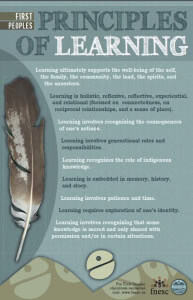
Link: First Peoples Principles of Learning – First Nations Education Steering Committee FNESC
These learning principles “were articulated by Indigenous Elders, scholars and knowledge keepers to guide the development of the curriculum and teaching of the the English First Peoples course created by the BC Ministry of Education and First Nations Education Steering Committee in 2006/2007” (FNESC, n.d.).
“They represent an attempt to identify common elements in the varied teaching and learning approaches that prevail within particular First Nations societies. It must be recognized that they do not capture the full reality of the approach used in any single First Peoples’ society” (FNESC, n.d.).
Jo Chrona: First Peoples Principles of Learning
Jo-Anne L. Chrona is a Ts’msyen author and educator of over twenty years. Jo created a website as a resource for teachers to help incorporate the First Peoples Principles of Learning (FPPL) into their classrooms and schools. It is an excellent resource for teachers to find ways to deepen their understanding of the FPPL, connect the FPPL to other educational theories, and connect these pedagogies to the classroom and curriculum.
Link: Jo-Anne Chrona – First Peoples Principles of Learning
Your Journey
Connection to Place and Land (Stewardship)
As educators and guests on the pentl’atch territory, we have a responsibility to learn, reflect and teach about whose territory we live on. Please take time to help your students connect to place and the land. Here are some suggestions for you to begin with as you paddle together on this journey.
- Inquiry Question: What do we know about the Comox (Pentl’atch) Lake area? What questions do we have?
- Understanding of the Land Acknowledgement: Whose territory are we on? Who are the caretakers and the stewards of this land? Carolyn Roberts, author of Re-Storying Education, shared this blog post about reflections on and of the land.
- Consider deepening connections by teaching about these topics:
- Pentl’atch territory – The pentl’atch are the original stewards and caretakers of this area.
- Migration of nations to this area – The E’iksan and K’omoks people moved into the area living with the Pentl’atch in the 1830’s and 1850’s respectively.
- Name of the lake: Pentl’atch – Salal Lake or Salal Pentl’atch. Comox Lake was named after settlers arrived and the migration of K’ómoks to the area.
- K’omoks First Nation has a very informative slideshow presentation written by Jesse Morin: Cultural Topography of Traditional Indigenous Land Use at Pentl’atch (the Comox Valley). https://komoks.ca/wp-content/uploads/2023/06/Morin-Cultural-Topography-Jun-19-2023.pdf
Story
- How can story connect us to place, history, and community?
- How can stories about the canoes’ names or Comox (Pentl’atch) Lake deepen our understanding of pentl’atch perspectives?
- What stories will the canoes capture and carry through these teachings?
- Connection: Legend of Queneesh
- Q’um Q’um Xiiem, Dr. Jo-ann Archibald, has a wonderful resource for teachers to learn about Indigenous storywork. https://indigenousstorywork.com/
Further Learning
We encourage you to guide your students through inquiry, asking questions such as:
- How were traditional Canoes utilized here is the past? Present?
- How are traditional canoes made?
- How are we sharing these new teachings and understanding?
- How does it shift your thinking around acknowledging territory?
- How do we walk differently?
To learn more about the reawakening of the Pent’atch language, please visit this website:
https://www.qualicumfirstnation.com/pentlach-alphabet